Coloring Books That Teach: How Creative Activities Boost Learning
Key Takeaways
- ✓Coloring activates multiple brain systems simultaneously: fine motor control, visual-spatial processing, sustained attention, bilateral coordination, and stress reduction.
- ✓Research published in Art Therapy found that coloring reduces cortisol levels in children, creating a calmer state more conducive to learning.
- ✓Children who regularly engage in coloring and drawing develop handwriting skills faster and with less frustration because coloring uses the same tripod grip needed for writing.
- ✓Educational coloring books with themed content (animals, space, dinosaurs) expose children to subject knowledge while building fine motor skills and focus.
Research shows that coloring does far more than keep kids busy. Discover how educational coloring books build fine motor skills, focus, creativity, and even academic knowledge.
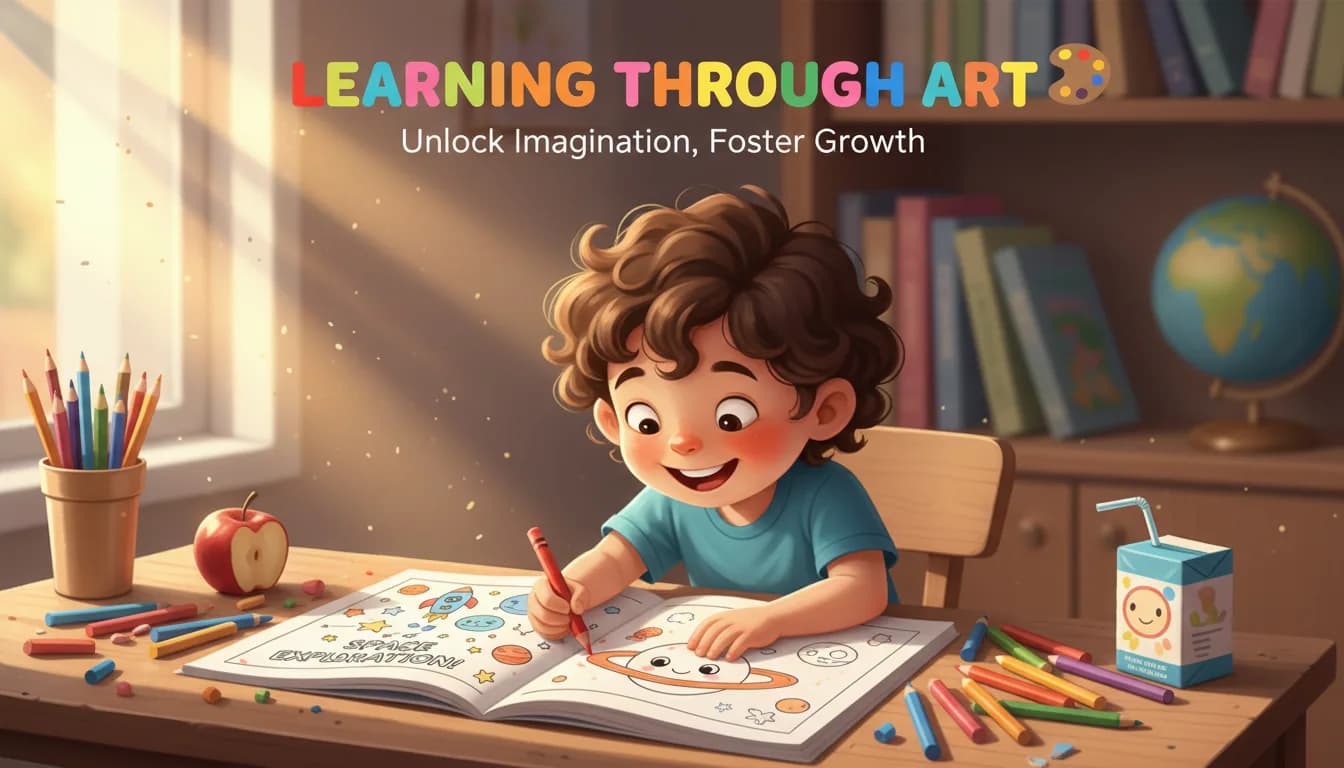
Coloring is often dismissed as a "filler" activity — something to hand kids when you need 20 minutes of quiet. But neuroscience tells a different story. Educational coloring books activate multiple brain systems simultaneously, building skills that support learning across every domain.
The Neuroscience of Coloring
When a child colors, their brain engages in:
- Fine motor control — The hand muscles used for coloring are the same ones needed for writing, typing, and instrument playing.
- Visual-spatial processing — Staying within boundaries, choosing colors, and planning the composition all engage spatial reasoning.
- Focus and attention — Coloring requires sustained concentration — the same attention skill needed for reading and math.
- Bilateral coordination — Holding the paper with one hand while coloring with the other strengthens the brain's corpus callosum (the bridge between hemispheres).
- Stress reduction — Research published in Art Therapy found that coloring reduces cortisol levels in children, creating a calmer state more conducive to learning.
What Makes a Coloring Book "Educational"?
Not all coloring books teach. The difference lies in the content and design:
- Themed content — Coloring books organized around topics (animals, space, history, science) expose children to subject matter while they color.
- Age-appropriate complexity — Designs that match developmental stages challenge without frustrating.
- Facts and labels — Educational coloring books often include interesting facts, vocabulary, or labels alongside images.
- Progressive difficulty — Starting simple and increasing detail builds both skill and confidence.
Benefit 1: Fine Motor Development
For children ages 4–8, coloring is one of the best fine motor activities available. The tripod grip used for crayons and colored pencils is the same grip needed for writing. Research shows that children who regularly engage in coloring and drawing activities develop handwriting skills faster and with less frustration.
Progressive coloring — starting with large, simple shapes and moving to detailed designs — builds hand strength and control naturally over time.
Benefit 2: Focus and Concentration
Completing a coloring page requires 10–30 minutes of sustained attention depending on complexity. For children who struggle with focus, coloring provides a structured, calming activity that trains the attention circuits without the pressure of academic work.
Many occupational therapists recommend coloring as a "focus warm-up" before homework or study sessions.
Benefit 3: Creativity and Self-Expression
Within the structure of a coloring page, children make dozens of creative decisions: Which colors? What shading? What mood? This constrained creativity — having freedom within a framework — mirrors the creative thinking used in problem-solving and innovation.
Educational coloring books with themed content add a dimension: a child coloring a dinosaur naturally wonders about its real color, habitat, and behavior — sparking curiosity and research impulses.
Benefit 4: Subject Knowledge
Themed educational coloring books introduce children to content areas in a relaxed, positive context. Our ThinkQuest AI coloring book collection includes four series:
- Amazing Animals — Wildlife from around the world with varying complexity across three books
- Space Explorers — Planets, rockets, astronauts, and cosmic phenomena
- Underwater Secrets — Marine life and ocean ecosystems
- Dinosaur Discovery — Prehistoric creatures and paleontology themes
Each series includes three books with unique content and increasing complexity — 12 coloring books total, each designed for ages 6–14.
How Coloring Connects to Critical Thinking
The link between coloring and critical thinking is more direct than you might expect:
- Planning — Choosing a color scheme before starting requires forethought and strategy.
- Decision-making — Every color choice is a small decision with consequences for the overall image.
- Error recovery — Coloring outside the lines or choosing a color you regret teaches adaptation and creative problem-solving.
- Observation — Detailed coloring pages build the careful observation skills that underpin scientific thinking and evidence evaluation.
Coloring Complexity by Age
- Ages 4–6: Large shapes, thick outlines, minimal detail. Focus on motor control and color recognition.
- Ages 6–9: Medium detail, thinner lines, themed content. Children begin making deliberate creative choices.
- Ages 10–14: High detail, intricate patterns, realistic subjects. Builds advanced focus and precision.
Ways to Extend Coloring Into Deeper Learning
- Research the subject. After coloring a dolphin, look up three facts about dolphins. Write them on the back of the page.
- Compare and discuss. Two children color the same page, then discuss their different choices. Why those colors? What mood does each version create?
- Create a story. After coloring several pages from a themed book, arrange them into a narrative. What story do the images tell?
- Pair with puzzles. Color a space scene, then solve a space-themed cipher. Thematic pairing deepens engagement.
- Mindful coloring. Color slowly and silently for 10 minutes. Focus on the sensation of the crayon on paper. This is meditation practice in disguise.
Explore Educational Coloring Books
Our ThinkQuest AI coloring book collection features 12 books across 4 series, each designed to combine the calming benefits of coloring with genuine learning. Every book carries the ThinkQuest AI brand and is available in print.
Pair coloring books with our maze books for spatial reasoning, word searches for vocabulary, and free online games for interactive critical thinking practice. Together, they create a complete toolkit for building smarter, more creative, more resilient thinkers.
Frequently Asked Questions
How do coloring books help children learn?
Coloring builds fine motor control (same grip as writing), visual-spatial processing (staying within boundaries), sustained attention (10-30 minutes of focus), and bilateral coordination (holding paper with one hand, coloring with the other). Themed coloring books add subject knowledge in areas like animals, space, and dinosaurs.
What makes a coloring book educational?
Educational coloring books differ from generic ones in four ways: themed content organized around learning topics, age-appropriate complexity that matches developmental stages, facts and vocabulary alongside images, and progressive difficulty that builds skill and confidence over time.
Are coloring books good for child development?
Yes. Research in Art Therapy shows coloring reduces cortisol (stress hormone) levels. Coloring also builds the fine motor skills needed for handwriting, trains sustained attention for 10-30 minutes, and develops bilateral coordination. Many occupational therapists recommend coloring as a focus warm-up before homework.
What age are educational coloring books appropriate for?
Ages 4-6 benefit from large shapes with thick outlines focusing on motor control. Ages 6-9 can handle medium detail and thinner lines with themed content. Ages 10-14 are ready for high detail and intricate patterns that build advanced focus and precision.
Try our free critical thinking games!
Fun, colorful brain-building games for kids ages 6-14. No signup required.
Play Now